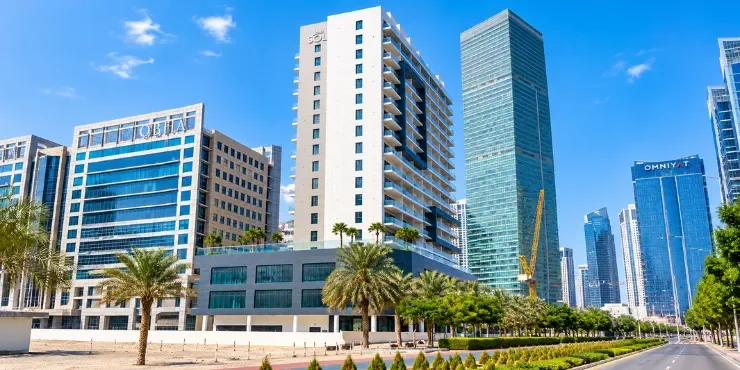
Off-Plan Townhouses in Dubai: A Complete Guide for Buyers in 2026
Off-plan townhouses in Dubai are sold before construction is complete, with the buyer paying in installments tied to the developer's construction schedule rather than in one lump sum. Townhouses have become one of the more active segments of Dubai's off-plan market because they combine a lower entry price than a villa with more space and privacy than an apartment. This guide covers how the purchase process works, which communities are seeing the most activity, what protects your payments, and what you'll pay beyond the listed price.
What "Off-Plan" Means for a Townhouse Purchase
When you buy an off-plan townhouse, you sign a sale and purchase agreement (SPA) for a unit that hasn't been built yet, based on the developer's floor plans, unit specifications, and a show home if one is available. Ownership is recorded through an interim registration called Oqood rather than a title deed, since a title deed can only be issued once the property physically exists. Payment is staged. You pay a booking deposit, then further installments as construction reaches defined milestones, and in some projects a portion after handover. This is different from buying a ready property, where the full amount (or mortgage-financed amount) is paid at transfer. Townhouses specifically are usually built within larger master-planned communities alongside villas and, increasingly, apartments. A typical unit has two to four bedrooms, a small private garden or courtyard, and access to shared community amenities such as parks, pools, and retail.
Why Demand for Off-Plan Townhouses Has Increased
A few factors explain the shift toward this property type:
- Longer-term residency - Longer-duration UAE visas have changed how expat families plan their housing. A family expecting to stay five to ten years is more likely to buy a townhouse than rent an apartment.
- Price relative to villas - A townhouse typically costs less per square foot than a standalone villa in the same community, while still offering private outdoor space and multiple bedrooms.
- International buyer base - Buyers of off-plan townhouses in Dubai come from a wide mix of nationalities UK, Chinese, European, Indian, Russian, and Middle Eastern buyers make up most of the demand, with growing interest from North American buyers.
- Phased pricing - Developers typically increase unit prices as a project moves through construction phases. Buyers who purchase in an early phase pay less than buyers who purchase later in the same project.
Communities With the Most Off-Plan Townhouse Activity
The following communities have active or recently launched off-plan townhouse inventory as of 2026: The Valley, Arabian Ranches, Dubai Hills Estate, Nad Al Sheba Gardens, DAMAC Hills 2, Haven by Aldar, Bay Villas, Riverside by DAMAC, La Tilia, and Jumeirah Village Circle. Emaar's Terra Woods project in Expo City Dubai is a newer example, combining townhouses and apartments within one master plan. These communities fall into two broad categories:
- Established communities (Arabian Ranches, Dubai Hills Estate) - Infrastructure, schools, and retail are already operating. Rental data exists from completed phases, which makes pricing and yield easier to verify. Remaining off-plan supply in these communities tends to be limited to final phases or infill plots.
- Newer master communities (The Valley, Nad Al Sheba Gardens, DAMAC Hills 2) - Prices are generally lower because the community is still being built out. There is less operating history to reference, and the completion timeline is typically longer.
Which category fits you depends on whether you're prioritizing verified performance or lower entry pricing.
How Off-Plan Townhouse Payment Plans Are Structured
Payment plans vary by developer and project, but most follow this structure:
- Booking deposit - typically 10% to 20% of the purchase price, paid at reservation to secure the unit and begin the SPA process.
- Construction-linked installments - additional payments due as the developer completes and verifies specific construction stages (for example, foundation complete, structure reaching a certain level, or MEP installation).
- Post-handover installments - on some projects, a portion of the price (commonly 10% to 40%) is paid in installments after you take possession of the unit, rather than in full at handover.
Before signing an SPA, request the full payment schedule in writing, including the exact percentage and due date for each installment, the conditions that trigger a milestone payment, and any fees not included in the base price (such as DEWA connection or community service charges).
Payment Protections: Escrow, RERA, and Oqood
Dubai's off-plan property sales are governed by a specific legal framework, not informal industry practice:
- Escrow accounts (Law No. 8 of 2007) - Developers are required to deposit all buyer payments into a project-specific escrow account held at a DLD-approved bank. Funds cannot be moved to the developer's general operating account. Withdrawals from escrow are permitted only after an independent engineer certifies that a construction milestone has been completed, and RERA reviews these withdrawals.
- Oqood registration - The DLD registers your interest in the unit through Oqood at the time of SPA signing. This is the legal record of your ownership claim before the title deed exists, and it links your unit to the project's escrow account. Oqood converts to a full title deed at handover without a second 4% transfer fee.
- RERA project registration - A developer cannot legally collect payment for a project until it is registered with RERA and an escrow account is in place. You can verify this registration directly with the DLD before paying a deposit.
Given this framework, outright fraud is uncommon in properly registered projects. The two risks that actually affect most buyers are construction delays past the agreed handover date, and underperformance in resale value or rental yield if the community or developer doesn't perform as expected. Both of these are risks you assess through developer research, not through the escrow system.
Due Diligence Steps Before Buying
- Review the developer's delivery history - Check how many of their previous projects were handed over on or near the original completion date, and how they handled post-handover defects. This information is more reliable than sales materials.
- Verify escrow and RERA registration directly with the DLD - Confirm the project's registration status before transferring a deposit.
- Understand the cancellation process - Under RERA rules, a buyer can typically only cancel a stalled project after a 12-month delay past the contractual handover date, or after RERA formally declares the project in default. Refunds are then processed through escrow, usually within 60 to 90 days. This is not a fast process, and it should not be treated as a way to exit a purchase quickly if you simply change your mind.
- Check the master plan for the full community, not just your building or cluster - Confirm what infrastructure, schools, and retail are planned for future phases, since these affect resale value once the community matures.
- Compare full payment schedules across shortlisted projects, not just headline prices - A project with a lower advertised price and a front-loaded payment schedule can require more cash earlier than a higher-priced project with a longer post-handover plan.
Who Should Invest in an Off-Plan Townhouse
- Families planning to live in Dubai long-term who can wait through a construction period of roughly two to four years and want more space and privacy than an apartment provides.
- Investors with a medium-term horizon who can hold through construction and the early post-handover period, when price appreciation is typically strongest.
- Buyers who need immediate occupancy, or who cannot accept the risk of a delayed handover, are better matched to ready (completed) properties rather than off-plan.
Conclusion
Off-plan townhouses in Dubai are backed by a regulatory structure, mandatory escrow, milestone-based fund release, and RERA project registration that limits the risk of the fund misuse that affected the market before 2008. That structure doesn't evaluate the developer's construction quality, the project's completion timeline, or whether the community will perform as advertised. Those factors are on the buyer to verify, through the developer's track record and the project's registered documentation, before signing the SPA.